Elevated Dog Bowls: Modern \& Ergonomic (2026)
Last updated: August 11, 2026 · Reading time: ~7 min · Research by HiPetTech editors
Quick answer: Elevated dog bowls raise your dog’s food and water to a comfortable height, improving posture and reducing neck strain — and for large and giant breeds they can lower the risk of bloat (gastric dilatation-volvulus). In 2026 the best models pair adjustable height with modern materials like ceramic, bamboo, and powder-coated steel so they look at home in a designed space. Our top pick for most homes is an adjustable stand that grows with your dog.
If you are building a coordinated, design-led pet corner, start with our pillar guide to aesthetic pet furniture for modern homes and then browse our curated best picks for the full decor lineup. Elevated feeding is also the natural companion to a minimalist dog crate furniture piece and a smart pet feeder review if you want scheduled, app-controlled meals at the right height.
Transparency note: This page contains Amazon affiliate links. If you buy through them, we may earn a commission at no extra cost to you. We only recommend products we genuinely believe are worth your money. Read our full disclosure →
- Elevated Dog Bowls: Modern \& Ergonomic (2026)
- Quick Verdict: Elevated Dog Bowls (2026)
- Why Elevated Dog Bowls Actually Matter
- Bloat, Posture \& Large Breeds
- Adjustable Height: PetZone vs IRIS
- Modern Materials: Ceramic, Wood \& Steel
- Our 2026 Comparison Table
- How to Choose the Right Height
- Setup, Cleaning \& real downsides
- FAQ
- Our Pick
- Closing Thoughts
Last checked: September 2026. Prices, availability and subscription terms change often — confirm the current price on Amazon before buying.
Quick Verdict: Elevated Dog Bowls (2026)
- Best overall: Adjustable-height steel stand with stainless bowls (PetZone-style) — grows with your dog, modern look, handles posture needs of large and senior dogs.
- Best for small homes: IRIS storage riser — combines elevated feeding with airtight kibble storage in one footprint.
- Best for design-led interiors: Ceramic-insert wooden stand — refined look, heavy bowls resist tipping, pairs with modern decor.
- Best for tiny kitchens: Wall-mount feeder — adjustable bracket, frees floor space, stable when properly installed.
Best for: Medium-to-large breeds, senior dogs with arthritis, giant breeds, dogs recovering from surgery, multi-dog households with different sizes. Not ideal for: Tiny toy breeds that eat comfortably at floor level, confirmed bowl-flippers, or homes where floor clutter is a major concern.
(Prices and stock can change; always verify on Amazon.)
Why Elevated Dog Bowls Actually Matter
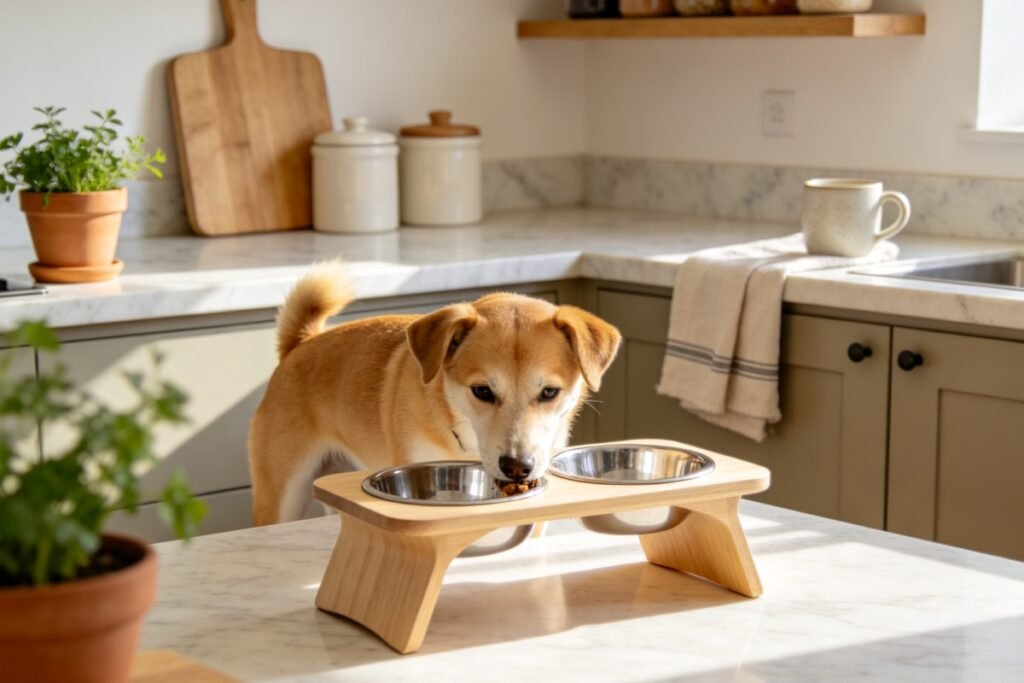
Most dogs eat from a bowl on the floor, which forces them to bend the full length of their neck and compress their throat with every swallow. For a Yorkshire terrier that angle is minor, but for a 90-pound Labrador or a 140-pound Great Dane, floor-level feeding means a deep, awkward crouch repeated two or three times a day for a decade. Elevated dog bowls solve this by bringing the rim of the bowl up to roughly the height of your dog’s lower chest, so the spine stays neutral and swallowing becomes a straight, gravity-assisted motion.
The ergonomic case is straightforward. When the bowl sits at the correct height, your dog no longer has to hunch the shoulders, crane the neck, or splay the front legs to reach food. Owners of senior dogs and dogs with arthritis frequently report that an elevated setup visibly reduces the “groan and shuffle” that precedes mealtime. Even younger, healthy dogs benefit from less mechanical strain over a lifetime of meals.
There is also a household-design argument. A well-made elevated feeder looks like intentional furniture rather than a plastic saucer abandoned on the kitchen tile. In 2026, the category has matured past the flimsy three-leg risers of a decade ago. You can now find stands in matte black steel, warm bamboo, and white oak that sit naturally beside a pet-friendly sofa or under a floating shelf. The bowl itself can be a glazed ceramic that you would happily leave on display.
For readers comparing feeding systems more broadly, our guide to designer slow feeder bowls covers puzzle-style options that slow gulping, and our aesthetic ceramic cat bowls article handles the feline side of the same design question.
Bloat, Posture \& Large Breeds
The single most important health reason to consider elevated dog bowls is bloat, clinically known as gastric dilatation-volvulus (GDV). This is a life-threatening condition in which the stomach fills with gas and can twist on itself, cutting off blood supply. Large and deep-chested breeds — Great Danes, Irish Wolfhounds, Weimaraners, Standard Poodles, German Shepherds, and similar — carry the highest risk.
Here is the nuance that responsible writers must convey: research on whether elevation prevents bloat has been mixed, and some older studies suggested that very large breeds fed from high risers actually showed higher GDV rates. The leading current interpretation is that height matters less than speed of eating and portion control, and that elevation is most helpful when it reduces the air a dog gulps while scrambling at floor level. In plain terms: elevation alone is not a bloat cure, but paired with a slow-feeder insert and measured portions, it is a sensible part of a bloat-risk reduction plan for big dogs.
What is unambiguous is the posture benefit. Veterinarians consistently note that raised feeding reduces strain on the neck, hips, and front limbs, which is valuable for:
- Senior dogs with arthritis or spondylosis
- Dogs recovering from shoulder or spinal surgery
- Giant breeds that simply bend a long way down to the floor
- Dogs with megaesophagus, where gravity-assisted eating is often recommended
If your dog is a confirmed fast inhaler of food, read our designer slow feeder bowls guide in parallel — many elevated stands accept a slow-feed bowl insert, giving you both posture support and speed control in one station.
Adjustable Height: PetZone vs IRIS
The biggest practical advance in the category is the adjustable-height feeder. A fixed stand is fine if your dog is already full grown, but puppies, rescues of unknown adult size, and multi-dog households all benefit from a riser that grows with the animal. Two brands dominate the accessible, well-reviewed end of this space: PetZone and IRIS.
PetZone Adjustable Raised Feeder
PetZone Adjustable Raised Feeder is the better-known name, typically offering four height settings (often around 4, 8, 12, and 14 inches depending on the model) that you reconfigure by flipping or stacking the frame. It ships with two stainless steel bowls and a frame that reads as modern rather than clinical. The steel bowls are rust-resistant and dishwasher safe, and the frame wipes clean. Owners like that one stand genuinely covers a dog from puppyhood through adulthood, which is the core value proposition.
IRIS Elevated Feeder with Storage
IRIS Elevated Feeder with Storage takes a different angle: many IRIS designs combine the riser with a built-in airtight food storage bin beneath the bowls. For small-to-medium homes this is a tidy two-in-one — you elevate the meal and hide the kibble in the same footprint. IRIS heights are usually fixed per model (commonly 4, 8, or 12 inches), so the trade-off is less growth flexibility in exchange for integrated storage and a lower price.
| Feature | PetZone Adjustable | IRIS with Storage |
|---|---|---|
| Height options | 4 adjustable settings | Fixed per model (4/8/12 in) |
| Bowls included | 2 x stainless steel | 2 (stainless or plastic rim) |
| Extra function | Pure feeder | Airtight kibble storage |
| Best for | Growing / multi-size dogs | Space-saving small homes |
| Style | Modern steel frame | Practical utility look |
(Prices and stock can change; always verify on Amazon.)
The straight call: choose PetZone if your dog is still growing or you foster different sizes; choose IRIS if you want to consolidate feeding and storage in a single, budget-friendly unit.
Modern Materials: Ceramic, Wood \& Steel
Floor bowls are almost always plastic, and plastic is the enemy of a designed interior. The 2026 elevated category lets you choose materials that match the room.
Ceramic bowls are the aesthetic high point. A glazed ceramic bowl in matte white, sage, or terracotta looks like a piece of kitchenware, not pet gear. Ceramic is also heavy, so it resists tipping, and it is naturally odor-resistant and easy to sanitize. The downside is fragility — a dropped ceramic bowl can chip, and it is heavier to lift for washing. Many modern elevated stands now offer ceramic inserts sized to the frame.
Wood and bamboo frames bring warmth. Bamboo especially is sustainable, water-resistant when sealed, and reads as “furniture.” The caution is moisture: a wooden frame needs a waterproof bowl well and regular drying, or it will warp near the water dish. Powder-coated steel frames avoid that problem entirely and suit a minimalist or industrial interior, though steel can feel cold and show water spots.
Stainless steel bowls remain the hygienic default and are what most adjustable stands ship with. They are indestructible, dishwasher safe, and non-porous. The “designer” move is to pair a stainless working bowl with a beautiful frame so you get function where it counts and looks where it shows.
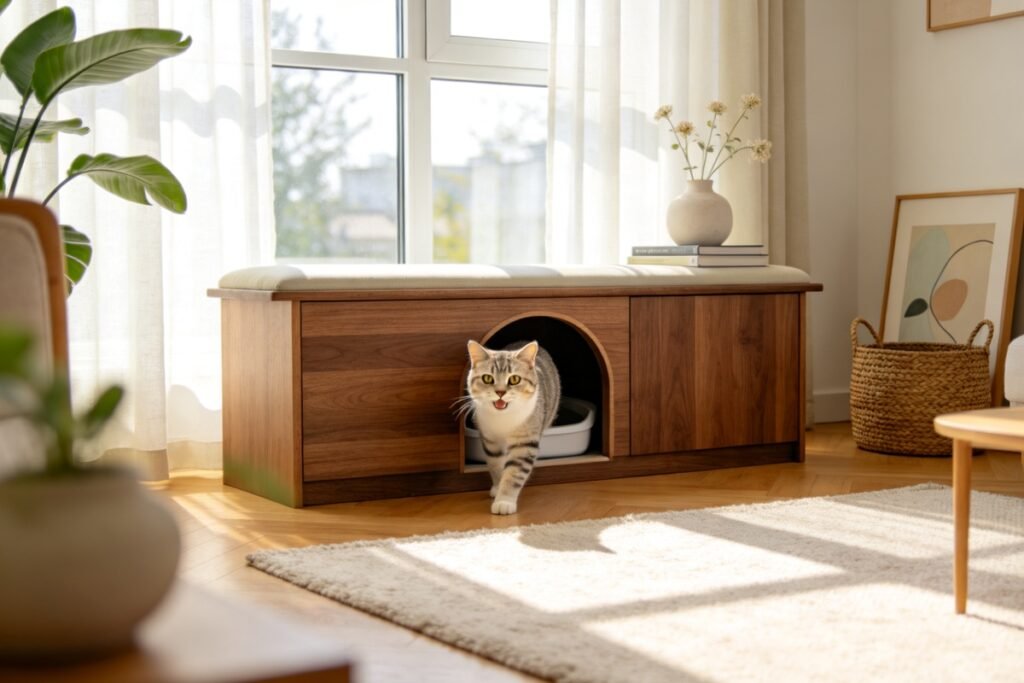
If your interior leans coastal or Japandi, a cat litter box enclosure furniture piece and a wooden elevated feeder share the same material language and keep the room cohesive.
Our 2026 Comparison Table
Below is a consolidated view of the categories we recommend, using the placeholder links for live pricing.
| Category | Best For | Material | Height Flex | Check Price |
|---|---|---|---|---|
| Adjustable steel stand | Growing dogs, large breeds | Steel + SS bowls | Yes (4 settings) | |
| Storage riser | Small homes | Plastic/steel + bin | No (fixed) | |
| Ceramic insert stand | Design-led interiors | Wood + ceramic | Often fixed | |
| Wall-mount feeder | Tiny kitchens | Steel bracket | Adjustable bracket |
Remember that final prices and in-stock status change constantly, so always confirm the current figure through the link rather than trusting a cached number.
How to Choose the Right Height
The rule of thumb: the top rim of the bowl should sit roughly level with your dog’s withers (the point of the shoulders) or slightly below the lower chest. A simple method is to measure from the floor to the dog’s elbow, then subtract about 4 to 6 inches; the remainder is a good bowl-rim height for many dogs. For giant breeds, level-with-elbow or just below is usually comfortable.
Practical tips:
- Puppies: start low and raise the stand as they grow; adjustable models shine here.
- Two dogs, different sizes: use two separate single-bowl stands at each dog’s height, or pick an adjustable model you can set per meal.
- Water vs food: some dogs prefer water slightly lower; experiment within a couple of inches.
- check it: watch for signs the height is wrong — neck still craned (too low) or front paws lifting the body (too high).
If you also run a scheduled feeder, our PETLIBRO Granary smart feeder review explains how app scheduling pairs with a stable stand for consistent meal heights.
Setup, Cleaning \& real downsides
Elevated dog bowls are low-maintenance, but a few realities deserve a straight answer.
Cleaning. Stainless and ceramic bowls go in the dishwasher. Wooden frames need hand-wiping and must be kept dry. The frame’s bowl well should be wiped weekly to avoid slime buildup where the rim meets the stand.
Stability. Cheap risers wobble, which spooks nervous dogs. Spend up for a wide, weighted, or screw-together base. Non-slip feet are non-negotiable on hardwood or tile.
The bloat caveat (restated). We will not overclaim. Elevation is one factor among several (speed of eating, portion size, breed risk, exercise timing). Do not rely on a raised bowl alone to prevent GDV, and avoid vigorous play right after large meals regardless of bowl height.
Who should skip this. If you have a tiny toy breed that already eats comfortably at floor level, a riser adds clutter with little benefit. If your dog is a confirmed bowl-flipper, a weighted low dish may be simpler than a tall stand they can shoulder over.
For the broader decor picture, our aesthetic pet furniture pillar ties feeders, beds, and hides into one coordinated room plan.
FAQ
Are elevated dog bowls safe for all dogs?
Elevated bowls are safe and helpful for most medium-to-large and senior dogs because they improve posture and reduce neck strain. For very small toy breeds the benefit is minimal, and for giant breeds the height should be chosen carefully as part of a broader bloat-risk plan rather than a standalone solution. Always match rim height to your dog’s elbow measurement.
Do elevated bowls actually prevent bloat?
The evidence is mixed. Elevation reduces the awkward crouch and may cut the air a dog gulps while eating fast, but studies have not proven it prevents gastric dilatation-volvulus on its own. The strongest approach combines a raised, stable feeder with a slow-feeder insert, measured portions, and avoiding hard exercise after meals.
What height should my dog’s bowl be?
Measure from the floor to your dog’s elbow and subtract roughly 4 to 6 inches for a comfortable rim height; many owners aim for the rim near the lower chest or withers. Adjustable stands are ideal for puppies and growing dogs because you can raise the bowl as they mature. Watch your dog eat and fine-tune within a couple of inches.
Are ceramic elevated bowls better than stainless?
Ceramic bowls look more refined and resist odors, but they are heavier and can chip if dropped. Stainless steel is virtually indestructible, dishwasher safe, and hygienic, which is why most adjustable stands ship with it. The best designer setups pair a stainless working bowl with a beautiful wood or steel frame for both function and style.
Can I use an elevated stand with a smart feeder?
Yes. Many owners place a scheduled feeder like those covered in our smart feeder review on or beside a stable stand to keep meal height consistent. Ensure the feeder’s footprint is stable and that cords are managed away from chewing. Check current specs on Amazon for exact dimensions before pairing devices.
Our Pick
For the widest range of homes, we pick an adjustable-height steel stand with stainless bowls (PetZone-style) as the best all-rounder: it grows with your dog, looks modern, and handles the posture needs of large and senior dogs without breaking the bank. If your priority is a designed interior above all, choose a ceramic-insert wooden stand for the showpiece look. And if floor space is tight, the IRIS storage riser earns its place by hiding kibble in the same footprint.
(Prices and stock can change; always verify on Amazon.)
Closing Thoughts
Elevated dog bowls are one of the rare pet upgrades that help your dog and your room at the same time. Pick the height first, the material second, and you will land on a feeder that earns its spot in a modern home. Subscribe to our newsletter at HiPetTech’s about page for new decor drops and research-based comparisons.
Disclosure \& Transparency
This post contains affiliate links to Amazon and other retailers. As an Amazon Associate, we earn from qualifying purchases at no extra cost to you. This site is research-based: recommendations are built from brand specifications, large-scale user reviews, long-term feedback in pet communities, and reliability signals such as firmware updates and parts availability. We do not claim personal in-house testing of every unit. Prices and stock levels can change at any time; always verify on the retailer’s page before purchasing. Read our full editorial and affiliate policy →
这是第 1 篇的完整优化稿。如果您还有更多原文(第 2 篇、第 3 篇等),