Designer Slow Feeder Bowls (2026): Stylish \& Functional
Last updated: August 11, 2026 · Reading time: ~7 min · Research by HiPetTech editors
Quick answer: A slow feeder bowl uses ridges, maze walls, or puzzle compartments to force your dog or cat to eat more slowly, which reduces vomiting, bloating risk, and rapid weight gain from gulping. In 2026 the category has a designer wing — think Neater and Paw5 — that pairs these health benefits with ceramics, bamboo, and modern forms once reserved for ordinary decor. Our pick for most homes is a maze-style bowl that is both effective and attractive.
Start with our pillar guide to aesthetic pet furniture for modern homes and browse the curated best picks for the wider decor lineup. A slow feeder sits naturally beside an elevated dog bowl setup for large breeds, and pairs with a smart pet feeder review if you want scheduled, portion-controlled meals that also slow the inhale.
Transparency note: This page contains Amazon affiliate links. If you buy through them, we may earn a commission at no extra cost to you. We only recommend products we genuinely believe are worth your money. Read our full disclosure →
- Designer Slow Feeder Bowls (2026): Stylish \& Functional
- Quick Verdict: Designer Slow Feeder Bowls (2026)
- What a Slow Feeder Bowl Actually Does
- Health Angle: Bloat, Weight \& Vomiting
- Mainstream Workhorses: Outward Hound \& UPSKY
- The Designer Wave: Neater \& Paw5
- Our 2026 Comparison Table
- Choosing the Right Difficulty Level
- real downsides \& Who Should Skip
- FAQ
- Our Pick
- Closing Thoughts
Last checked: September 2026. Prices, availability and subscription terms change often — confirm the current price on Amazon before buying.
Quick Verdict: Designer Slow Feeder Bowls (2026)
- Best overall (function + value): Outward Hound intermediate maze — cheap, proven, available in multiple difficulty levels.
- Best for messy/gulping eaters: UPSKY wide-base maze — broad footprint limits spillover, budget-friendly.
- Best for design-led homes: Neater-style designer slow feeder — contained, modern aesthetic, keeps floors clean.
- Best for enrichment-focused owners: Paw5 snuffle-style foraging bowl — natural, tactile look, mental stimulation.
Best for: Gulping dogs, large deep-chested breeds (bloat risk), overweight pets, dogs that vomit after eating, food-motivated pets needing enrichment. Not ideal for: Free-feeding grazers who already eat slowly, flat-faced breeds without careful selection, dogs with severe dental disease, or owners unwilling to clean maze crevices thoroughly.
(Prices and stock can change; always verify on Amazon.)
What a Slow Feeder Bowl Actually Does
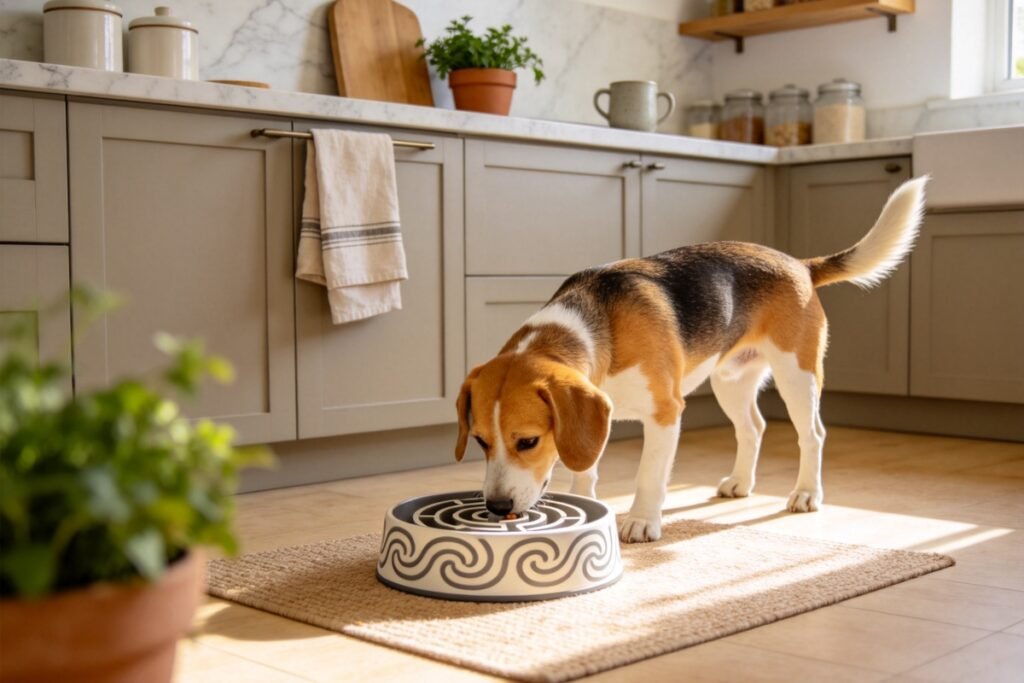
A slow feeder bowl is any feeding dish engineered so the animal cannot take a full-mouth scoop. Instead of a smooth, open well, the bowl has built-in obstacles — spiral walls, flower-shaped ridges, random bumps, or separated lily-pad compartments — that force the pet to navigate around them, licking and nudging food into reachable bites. The mechanical effect is a longer meal: a dog that finishes in 30 seconds might take 5 to 10 minutes.
This is not a gimmick. Eating speed is a real welfare and health variable. When a pet bolts food, they also swallow large amounts of air, which contributes to gas and discomfort, and they bypass the natural satiety signals that tell the brain “you are full.” Slowing the meal gives those signals time to register, which is why slow feeders are routinely recommended by trainers and vets for gulpers.
There is also a mental-enrichment angle. Negotiating a maze engages the pet’s problem-solving instincts, turning a 30-second chore into a few minutes of low-stress “work.” For food-motivated dogs left alone during the day, that small enrichment can take the edge off boredom.
For the feline version, our aesthetic ceramic cat bowls guide covers shallow whisker-friendly dishes, but note that most cat slow feeders follow the same maze principle in a smaller footprint.
Health Angle: Bloat, Weight \& Vomiting
The three headline health reasons to use a slow feeder bowl:
Bloat Risk (Large Breeds)
Gastric dilatation-volvulus is life-threatening, and fast eating with excess air swallowing is a recognized contributing factor, especially in deep-chested large breeds. A slow feeder is not a complete bloat solution, but it directly addresses the speed-and-air component. Pair it with the posture benefits covered in our elevated dog bowls guide.
Weight Management
Pets that eat slowly tend to feel satisfied on the same portion. For overweight dogs and cats, a slow feeder is a zero-cost tool alongside measured portions and exercise. It does not reduce calories, but it helps the animal register fullness instead of immediately begging for more.
Regurgitation and Vomiting
Many dogs that “throw up right after eating” are simply eating too fast and exercising too soon. Slowing the meal and then enforcing a calm rest period reduces these episodes markedly.
The plain caveat: a slow feeder manages speed, not quantity. If the portion itself is too large, the dog will still gain weight — just more slowly. Use it with a measured scoop and, where helpful, a smart feeder that portions automatically.
Mainstream Workhorses: Outward Hound \& UPSKY
For proven, affordable, widely available slow feeders, two names dominate: Outward Hound and UPSKY.
Outward Hound Fun Feeder
Outward Hound Fun Feeder is the category default — a swirling, flower-burst maze in multiple sizes and difficulty levels (often labeled purple for beginner, pink for intermediate, orange/blue for expert). It is BPA-free plastic, dishwasher safe on the top rack, and cheap enough to own several. The brand also makes a “Slo-Bowl” for very large dogs and a kitten-sized version. The trade-off is that it looks like pet gear, not decor.
UPSKY Maze Bowl
UPSKY makes similar maze bowls, often with a wider non-slip base and a slightly deeper maze, plus combination designs that include a lick-friendly central ridge. UPSKY bowls are popular for messy eaters because the broad footprint limits spillover. They are functional and budget-friendly but, again, utilitarian in appearance.
| Feature | Outward Hound | UPSKY |
|---|---|---|
| Difficulty levels | Multiple (beginner–expert) | Usually 1–2 levels |
| Material | BPA-free plastic | BPA-free plastic |
| Non-slip base | Some models | Broad base common |
| Look | Utilitarian | Utilitarian |
| Best for | Proven, cheap, sizes | Messy/gulping eaters |
(Prices and stock can change; always verify on Amazon.)
These are the workhorses. If your only goal is function at low cost, either is a safe buy. The designer options below exist for people who also care about the room.
The Designer Wave: Neater \& Paw5
The “designer slow feeder” segment answers a simple complaint: why does the healthy bowl have to look like a kids’ toy? Two brands lead the prettier, premium end.
Neater Designer Feeder
Neater (known for the Neater Feeder mess-proof system) brings a clean, modern aesthetic to slow feeding, often with a contained, splash-resistant frame and coordinated colors that read as kitchenware. The value is a tidier feeding station overall — the bowl plus a catch basin that keeps floors clean — which suits design-led homes.
Paw5 Snuffle-Style
Paw5 is best known for the Paw5 Wooly Snuffle Mat, but its slow-feeding philosophy — mimic foraging — has influenced designer bowls that look like textured stone or woven forms. These pieces prioritize a natural, tactile look and mental enrichment over the hard plastic maze. For owners who dislike rigid ridges, the softer “snuffle” style is a stylish compromise.
The designer tier costs more and is sometimes less aggressive at slowing extreme gulp-winners than a hard orange Outward Hound expert maze. So match the tool to the problem: extreme inhaler → proven hard maze; moderate speed + decor priority → designer bowl.
Our aesthetic pet furniture pillar shows how a designer bowl fits a coordinated station.
Our 2026 Comparison Table
| Bowl | Style | Difficulty | Material | Check Price |
|---|---|---|---|---|
| Outward Hound Fun Feeder | Maze, playful | Beginner–Expert | BPA-free plastic | |
| UPSKY maze bowl | Maze, wide base | Mild–Moderate | BPA-free plastic | |
| Neater designer feeder | Contained, modern | Mild–Moderate | Coated/plastic+steel | |
| Paw5 snuffle-style | Foraging texture | Mild | Fabric/stone look |
Confirm live pricing through the links, since promotions shift weekly.
Choosing the Right Difficulty Level
Slow feeders are not one-size-fits-all. Picking the wrong difficulty backfires: too easy and the dog still bolts; too hard and a frustrated pet gives up or flips the bowl.
Difficulty Levels Explained
- Beginner (mild ridges): Small dogs, seniors, or pets new to slow feeding. Eases the transition.
- Intermediate: Average gulp-speed dogs; the standard Outward Hound pink level works for many.
- Expert (tight maze): Confirmed power-inhalers and large breeds that finish in under a minute.
- Puzzle/brick style: For dogs that need enrichment, not just speed control — these add removable tabs.
Transition Tips
- Start one level easier than you think; bump up if the dog still finishes fast.
- Supervise the first few meals to ensure the pet eats calmly and does not chew the bowl.
- For wet food, choose a bowl with shallower wells or a lick mat; deep dry-food mazes clog with pâté.
- Keep the bowl stable — a non-slip mat under a lightweight plastic maze prevents skating.
If your dog also benefits from raised posture, see our elevated dog bowls article for stands that accept slow-feed inserts.
real downsides \& Who Should Skip
Straight talk on the limits:
Cleaning Is Harder
Maze bowls trap food in crevices; a bottle brush or top-rack dishwasher cycle is essential. Skip a slow feeder if you will not clean it thoroughly — trapped kibble invites bacteria.
Not for Flat-Faced Breeds Without Care
Brachycephalic dogs (bulldogs, pugs) can struggle with deep mazes; choose a shallow, wide slow feeder and watch closely.
Some Dogs Hate It
A small number of pets get frustrated and stop eating. If that happens, drop to an easier level or return to a normal bowl and address speed another way (smaller, more frequent meals via a smart feeder).
Plastic Wear
Cheap maze bowls scratch and can be chewed by power chewers; the designer coated or ceramic options resist this better but cost more.
Who Should Skip
- Free-feeding grazers who already eat slowly gain little.
- Dogs with severe dental disease may find mazes uncomfortable — check with your vet.
FAQ
Do slow feeder bowls really help with bloating?
They help with the speed-and-air component of bloat risk, which is a recognized contributing factor, especially in large deep-chested breeds. A slow feeder is not a standalone cure for gastric dilatation-volvulus, but slowing the meal and reducing swallowed air is a sensible part of a broader plan that may also include raised feeding and portion control.
Are slow feeders good for weight loss?
Indirectly, yes. Eating slowly gives satiety signals time to reach the brain, so a pet often feels satisfied on the same measured portion instead of begging immediately after. A slow feeder does not cut calories, so pair it with correct portion sizes and exercise. For precise control, a smart feeder can portion automatically.
Which slow feeder is best for aggressive eaters?
The Outward Hound expert-level maze (often the orange or blue “expert” version) is the go-to for power inhalers because its tight ridges force the most navigation. UPSKY wide-base mazes are a solid alternative for messy eaters. If even those are too easy, move to a puzzle brick with removable tabs or a snuffle mat for maximum slowdown.
Can cats use slow feeder bowls?
Yes, in smaller, shallower designs. Many cats bolt food too, and a kitten-sized maze or a lick mat slows them and adds enrichment. Choose a shallow cat-appropriate maze to avoid whisker stress, and our ceramic cat bowls guide covers whisker-friendly shapes if your cat rejects deep dishes.
Are designer slow feeders worth the extra money?
If the bowl sits in a visible room and you care about aesthetics, a Neater or Paw5-style designer bowl is worth it for the coordinated look and often better materials. If the bowl lives in a utility area and function is everything, a budget Outward Hound or UPSKY does the job for far less. Match the spend to where the bowl lives and how aggressively your pet eats.
Our Pick
For the average gulping dog, the Outward Hound intermediate maze is the pragmatic winner — cheap, proven, and available in the right difficulty. But for the design-led home this article is really about, we recommend a Neater-style designer slow feeder as the showpiece: it slows the meal, contains the mess, and looks intentional. Buy the hard maze for extreme inhalers; buy the designer bowl when looks matter as much as function.
(Prices and stock can change; always verify on Amazon.)
Closing Thoughts
Designer slow feeder bowls let you protect your pet’s health without sacrificing your room’s look. Match the difficulty to the eater, the material to the decor, and you win on both fronts. Subscribe at HiPetTech’s about page for new decor and feeding comparisons.
Disclosure \& Transparency
This post contains affiliate links to Amazon and other retailers. As an Amazon Associate, we earn from qualifying purchases at no extra cost to you. This site is research-based: recommendations are built from brand specifications, large-scale user reviews, long-term feedback in pet communities, and reliability signals such as firmware updates and parts availability. We do not claim personal in-house testing of every unit. Prices and stock levels can change at any time; always verify on the retailer’s page before purchasing. Read our full editorial and affiliate policy →
这是第 2 篇的完整优化稿。