Cute Dog Sweaters for Small Dogs (2026 Picks)
Last updated: August 5, 2026 · Reading time: ~8 min · Research by HiPetTech editors
The best cute dog sweaters for small dogs pair a stretchy acrylic or fleece knit with a chest-girth size chart (XS–XL), a high-cut belly panel that stays dry, and a neck opening that doesn’t press the trachea. Gooby, Blueberry Pet, and Canada Pooch lead the small-breed category because they publish real measurements instead of vague S/M/L labels.
Start with the wider wardrobe picture in our style hub, pet outfit ideas for every season, then come back here to nail the fit. For a broader shortlist across the fashion silo, see HiPetTech best picks.
Transparency note: This page contains Amazon affiliate links. If you buy through them, we may earn a commission at no extra cost to you. We only recommend products we genuinely believe are worth your money. Read our full disclosure →
- Cute Dog Sweaters for Small Dogs (2026 Picks)
- Quick Verdict: Cute Dog Sweaters for Small Dogs (2026)
- Why Small Dogs Genuinely Need Sweaters
- How to Size Cute Dog Sweaters for Small Dogs (XS to XL)
- Sweater Materials Compared: Acrylic, Wool Blend, Fleece
- Our Top Small-Dog Sweater Brands for 2026
- Brand Comparison Table
- Best Sweater Styles by Breed
- Large-Breed Sweater Options That Actually Fit
- Who Should Skip a Dog Sweater
- Washing, Storage, and Making Knits Last
- FAQ
- Our Pick
Last checked: September 2026. Prices, availability and subscription terms change often — confirm the current price on Amazon before buying.
Quick Verdict: Cute Dog Sweaters for Small Dogs (2026)
- Best overall fit: Gooby — XXS–S proportions taken seriously, stretch-panel construction, roomy necklines for tracheal comfort.
- Best for coordinated looks: Blueberry Pet — pattern continuity across sweaters, collars, leashes, and bandanas.
- Best for cold climates: Canada Pooch — heavier, fleece- or sherpa-lined knits designed for real winter use.
Best for: Small breeds (Chihuahua, Yorkie, Pomeranian, Mini Dachshund), thin-coated dogs, seniors, and owners in cold climates. Not ideal for: Heavy double-coated breeds (Husky, Malamute), determined chewers, dogs that freeze or refuse to walk in clothing, or mild climates that never drop below 55°F.
(Prices and stock can change; always verify on Amazon.)
Why Small Dogs Genuinely Need Sweaters
There is a real physiological reason toy breeds shiver first. Small dogs have a high surface-area-to-body-mass ratio, so they radiate heat far faster than a Labrador does. Add thin single coats (Chihuahuas, Italian Greyhounds, smooth Dachshunds), low body fat, and short legs that put the belly inches from frozen pavement, and you get an animal that loses core temperature quickly on an ordinary winter walk.
Common veterinary guidance flags temperatures under roughly 45°F as the point where thin-coated small dogs benefit from a layer, and under 32°F as the point where a layer is close to mandatory outdoors. Seniors, post-surgical dogs with shaved patches, and arthritic dogs also do better warm — the same logic behind putting a stiff senior on one of the best orthopedic dog beds indoors.
Then there is the straight reason most of us buy them: they’re adorable. That’s fine — just don’t let cuteness override fit, because a badly fitted knit is worse than no knit at all.
Signs your dog is actually cold
- Shivering that stops as soon as you get indoors
- Tucked tail, hunched back, lifting paws off the ground
- Slowing down or refusing to continue a familiar walk route
- Beelining for heat vents, laps, or blankets the moment you’re home
How to Size Cute Dog Sweaters for Small Dogs (XS to XL)
Ignore your dog’s weight. Weight is the worst possible sizing input, because a 10-lb barrel-chested Pug and a 10-lb whippet-shaped Min Pin need completely different garments. Measure instead.
Three measurements you need:
- Neck girth — around the base of the neck where a collar sits, with two fingers of slack.
- Chest girth — the widest point just behind the front legs. This is the make-or-break number.
- Back length — from the base of the neck to the base of the tail. Never measure past the tail.
Match chest girth to the brand’s own chart, not a generic one. Most small-dog ranges break down roughly as below, though every brand shifts the boundaries by an inch or two.
| Size | Typical chest girth | Typical back length | Common breeds |
|---|---|---|---|
| XS | 11–13 in | 8–10 in | Teacup Chihuahua, toy Yorkie |
| S | 13–16 in | 10–12 in | Chihuahua, Yorkie, Maltese |
| M | 16–19 in | 12–15 in | Pomeranian, Shih Tzu, Mini Dachshund |
| L | 19–23 in | 15–18 in | Pug, Frenchie, Boston Terrier |
| XL | 23–27 in | 18–21 in | Cocker Spaniel, small Corgi |
Sizing rules that prevent returns:
- Between sizes? Size up for double coats (Pomeranian, Shih Tzu), down for sleek deep-chested dogs (Italian Greyhound, Min Pin).
- Deep-chested breeds should size by chest and accept a shorter back length, never the reverse.
- The sweater should end before the genitals on males. A knit that gets soaked on every walk gets worn exactly once.
- You should slide two flat fingers under the neck opening. Tighter restricts the trachea — a real concern for collapsing-trachea-prone Yorkies and Poms.
Sweater Materials Compared: Acrylic, Wool Blend, Fleece
Material determines warmth, washability, and how long the garment survives a dog who rolls in mud.
| Factor | Acrylic knit | Wool blend | Fleece |
|---|---|---|---|
| Warmth | Good | Best | Good–very good |
| Machine washable | Yes | Usually hand wash | Yes |
| Itch risk | Very low | Moderate | Very low |
| Snag resistance | Moderate | Low | High |
| Dries fast | Moderate | Slow | Very fast |
| Best for | Everyday cute knits | Cold-climate warmth | Active or wet-weather dogs |
Acrylic is the workhorse of the cute-sweater world. It takes dye beautifully — hence the endless Fair Isle, cable-knit, and reindeer patterns — costs less, and survives the washing machine. Its weakness is pilling after repeated washes.
Wool blends are warmest per ounce and naturally odor-resistant, but demand gentler care, and some dogs react with itching. If your dog scratches at the shoulders within minutes, switch materials rather than assuming it’s a fit problem.
Fleece is the practical pick for rainy or slushy climates: it dries fast and resists snagging on brush. Less “knitwear cute,” but modern fleece pullovers come in enough colors to work in a coordinated look.
Our Top Small-Dog Sweater Brands for 2026
Gooby — the fit specialist for tiny and deep-chested dogs
Gooby built its reputation on small breeds specifically, and it shows in the patterning. Their knits track a published chest measurement closely, neck openings are generous enough for tracheal comfort, and many models use stretch-panel construction that accommodates the odd proportions of Chihuahuas and Italian Greyhounds. If you’ve historically bought sweaters that fit the chest but hung off the back, start here. Gooby’s other edge: genuine XXS and XS availability, which most brands simply don’t stock.
(Prices and stock can change; always verify on Amazon.)
Blueberry Pet — the coordinated-wardrobe brand
Blueberry Pet is the label to buy if you want the sweater to match the collar, leash, and bandana. Their design language stays consistent season to season, so this year’s cable-knit still coordinates with next year’s accessories. The size range is wide enough that a multi-dog household can dress a Yorkie and a Beagle in the same pattern. That coordination logic is exactly what we build on in our dog bandana styling ideas guide.
(Prices and stock can change; always verify on Amazon.)
Canada Pooch — the cold-climate performer
Canada Pooch sits at the warmer, more technical end. Their knits are heavier, often fleece- or sherpa-lined, and the brand’s cold-weather DNA means sizing assumes real winter use rather than indoor cuteness. If you get genuine sub-freezing months, this is where a sweater starts overlapping with outerwear — at which point read our guide to dog winter coats for cold weather and decide whether you need a coat instead of, or layered over, the knit.
(Prices and stock can change; always verify on Amazon.)
Brand Comparison Table
| Feature | Gooby | Blueberry Pet | Canada Pooch |
|---|---|---|---|
| Best for | Tiny + deep-chested dogs | Coordinated outfits | Genuine cold climates |
| Size range | XXS–XL (strong small end) | XS–XL+ | XS–XL |
| Typical material | Acrylic / fleece blends | Acrylic knits | Heavier lined knits |
| Leash-hole design | Common | Common | Varies by model |
| Machine washable | Usually | Usually | Check model care tag |
| Buy |
Specs vary by model and change between seasons — always check current specs and the brand’s own size chart on Amazon before ordering.
Best Sweater Styles by Breed
Chihuahua
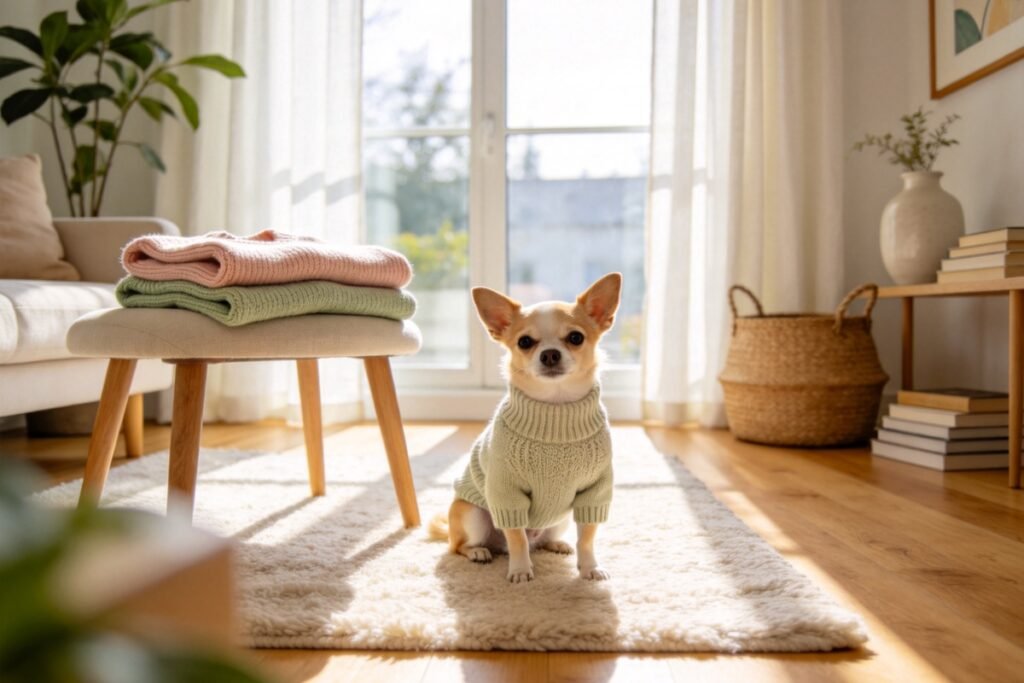
The classic sweater breed: minimal coat, minimal body fat, big heat loss. Look for XXS–S with a snug neck, a turtleneck or high collar for extra warmth, and a shorter back length. Avoid heavy chunky cable knits that overwhelm a 5-lb frame — the weight genuinely affects their gait. Lightweight ribbed acrylic is the sweet spot.
Yorkshire Terrier
Yorkies have long, fine, hair-type coats that mat under friction. Choose smooth-faced knits (tight gauge, minimal loose yarn) rather than chunky loops that catch hair at the armpits. A smooth fleece pullover is often kinder to a full-coated Yorkie than textured wool. Prioritize a wide, non-constricting neck given the breed’s tracheal risk.
Pomeranian
Poms already carry a dense double coat, so they need less insulation than you’d think and more room than you’d think. Size up. Look for open necklines that don’t crush the ruff, and consider a sleeveless vest-style knit so the coat isn’t compressed and matted at the shoulders. In mild weather a Pom may need a bandana more than a sweater.
Dachshund, French Bulldog, Pug
The “wrong-proportion” breeds. Dachshunds need long back lengths with narrow chests; Frenchies and Pugs need wide chests with short backs. Buy from brands that publish both numbers separately. Flat-faced breeds also overheat quickly — take the sweater off indoors.
Large-Breed Sweater Options That Actually Fit
Large dogs get cold too, especially short-coated giants like Great Danes, Weimaraners, and Boxers, plus seniors with thinning coats. The problem is that most XL “large dog” sweaters are scaled-up small-dog patterns with no allowance for chest depth.
What to look for:
- Chest girth up to 30–40 in listed explicitly, not just “XL”
- Ribbed or paneled sides so the garment flexes with a deeper ribcage
- Fleece or fleece-lined construction — pure knit sags under its own weight at large sizes
- Reflective trim, since big dogs are often walked at dawn or dusk
Canada Pooch and Kurgo both extend meaningfully into large sizes. For a big dog you’ll usually get better value from a fleece-lined jacket than a decorative knit. Our roundup of best-selling dog clothes on Amazon in 2026 breaks down which large-size items hold their ratings past a thousand reviews.
Who Should Skip a Dog Sweater
Better to flag who should skip than oversell something useless.
- Heavy working double coats (Husky, Malamute, Samoyed, Great Pyrenees). A sweater traps heat against the undercoat and compresses the very loft that keeps them warm.
- Determined chewers who’ll destroy a knit in an afternoon. Buy fleece — it survives better and costs less to replace.
- Dogs who freeze in place, refuse to walk, or repeatedly back out of the garment. Some dogs genuinely dislike body pressure; try a bandana or lightweight vest instead.
- Mild climates that never drop below 55°F. You’re buying a photo prop, which is fine — just budget accordingly.
What to look for instead: almost no brand publishes a neck-girth number alongside chest and length, even though neck fit is the most common reason a sweater gets rejected by the dog. Consider also like proper harness slots rather than a small round hole that only fits a collar clip. Until that changes, measure the neck yourself and check reviewer photos for harness compatibility.
Washing, Storage, and Making Knits Last
- Wash inside out in a mesh bag on cold, gentle — the biggest factor in preventing pilling.
- Skip fabric softener. It coats acrylic fibers and reduces breathability.
- Air dry flat. Machine drying is what turns a size M into a size S, and wool blends will felt irreversibly.
- De-pill with a fabric shaver once a season instead of picking by hand, which pulls threads.
- Rotate two sweaters instead of washing one constantly. Knits recover their shape with rest days.
One bonus: sweaters cut loose hair on furniture during winter. If shedding is your main complaint, a calming dog bed for anxiety with a removable cover plus a sweater rotation helps noticeably.
FAQ
What size sweater does a 10-pound dog need?
Weight alone can’t answer this. A 10-lb Pug usually needs a size L because of chest width, while a 10-lb Yorkie takes a size S. Measure chest girth behind the front legs and back length from neck base to tail base, then match those numbers to the specific brand’s chart rather than a generic one.
Are cute dog sweaters for small dogs safe to leave on all day?
Not unsupervised, and not indoors in a heated home. Use a sweater for walks and short outdoor stints. All-day wear traps moisture against skin, can cause hot spots or matting, and creates a snag risk during crating or play. Take it off once you’re back inside.
Acrylic or wool — which is better for a dog sweater?
Acrylic wins for everyday use: machine washable, non-itchy, cheaper, and available in far more patterns. Wool blends win on warmth-to-weight and odor resistance, but need gentle washing and can irritate sensitive skin. For most small dogs in most US climates, a mid-weight acrylic knit is the practical choice.
Do dog sweaters work with a harness?
Only if the sweater has a proper harness slot or a wide back opening; many knits have a small collar hole a harness clip can’t reach. The reliable workaround is to put the harness on over the sweater — safer for control and it avoids stretching the knit at the opening.
When is it too cold for a small dog even with a sweater?
Below roughly 20°F a knit alone isn’t enough for a small or thin-coated dog. You need an insulated, wind-resistant coat with belly coverage, shorter outings, and paw protection. Layering a sweater under a shell coat is a legitimate cold-snap strategy.
Our Pick
Gooby is our overall winner for cute dog sweaters for small dogs. No other mainstream brand takes XXS–S proportions as seriously, and fit is the entire ballgame here — a beautiful sweater in the wrong shape ends up in a drawer. Gooby’s stretch-panel construction and roomy necklines solve the two problems (deep chests and tracheal pressure) behind most small-breed returns.
Choose Blueberry Pet instead if coordinating looks across multiple dogs, or across sweater-plus-bandana combos, matters more than millimeter-perfect fit. Their pattern continuity plays nicely with matching owner and dog outfit ideas.
Choose Canada Pooch instead if you live north of the snow line and need a knit that pulls real thermal weight.
(Prices and stock can change; always verify on Amazon.)
Want our seasonal pet-style shortlists? Subscribe via HiPetTech’s about page for sizing cheat sheets and straight skip-it verdicts.
Disclosure \& Transparency
This post contains affiliate links to Amazon and other retailers. As an Amazon Associate, we earn from qualifying purchases at no extra cost to you. This site is research-based: recommendations are built from brand specifications, large-scale user reviews, long-term feedback in pet communities, and reliability signals such as firmware updates and parts availability. We do not claim personal in-house testing of every unit. Prices and stock levels can change at any time; always verify on the retailer’s page before purchasing. Read our full editorial and affiliate policy →