Dog Bandana Styling Ideas: 9 Looks + How to Tie
Last updated: August 5, 2026 · Reading time: ~7 min · Research by HiPetTech editors
The best dog bandana styling ideas come down to three tie methods — the overhand knot, the necktie fold, and the classic triangle drape — layered onto four fabric families: plaid cotton, seasonal prints, personalized embroidery, and cooling mesh. Get the tie right and one square of fabric produces nine genuinely different looks without stressing your dog.
Bandanas are the cheapest entry point in the whole wardrobe, which is why they lead in pet outfit ideas for every season. For the wider fashion shortlist, browse HiPetTech best picks.
Transparency note: This page contains Amazon affiliate links. If you buy through them, we may earn a commission at no extra cost to you. We only recommend products we genuinely believe are worth your money. Read our full disclosure →
- Dog Bandana Styling Ideas: 9 Looks + How to Tie
- Quick Verdict: Dog Bandana Styling Ideas (2026)
- Why Bandanas Are the Easiest Win in Dog Style
- How to Tie a Dog Bandana: 3 Core Methods
- 9 Dog Bandana Styling Ideas That Actually Photograph Well
- 1. Classic Buffalo Plaid
- 2. Seasonal Florals for Spring
- 3. Personalized Name or Phone-Number Embroidery
- 4. Halloween and Christmas Holiday Looks
- 5. Tonal Monochrome with a Matching Collar
- 6. Bandana Layered Over a Sweater
- 7. Owner-Matching Bandana and Scarf
- 8. Reversible Two-Print Bandana
- 9. Cooling Bandana for Summer Walks
- Sizing: Matching Bandana Size to Neck Girth
- Fabric Guide: Cotton, Flannel, Mesh, and Cooling Weaves
- Blueberry Pet vs Rogz: Brand Comparison
- Safety Rules and Who Should Skip Bandanas
- Washing and Keeping Prints Sharp
- FAQ
- Our Pick
Last checked: September 2026. Prices, availability and subscription terms change often — confirm the current price on Amazon before buying.
Quick Verdict: Dog Bandana Styling Ideas (2026)
- Best overall brand: Blueberry Pet — seasonal print rotation plus matching collars, leashes, and sweaters for coordinated wardrobes.
- Best for durability: Rogz — bold solids, performance-leaning fabrics, survives swimming/digging/roughhousing.
- Best tie method for beginners: Over-the-collar triangle drape — removes knot-tightening risk, takes five seconds.
- Best everyday style: Buffalo plaid with overhand knot — forgiving fabric, forgiving knot, works with every coat color.
Best for: Owners who want easy, low-stress style; anxious dogs that reject sweaters/costumes; photo-ready looks without full outfits. Not ideal for: Brachycephalic dogs with tracheal sensitivity (use over-the-collar instead), dogs that chew fabric compulsively, or dogs recovering from neck/throat surgery.
(Prices and stock can change; always verify on Amazon.)
Why Bandanas Are the Easiest Win in Dog Style
A bandana solves the fundamental problem with dog fashion: most dogs tolerate very little of it. Sweaters restrict shoulders, costumes cover faces, boots trigger the funny high-step walk. A bandana touches nothing but the neck, weighs almost nothing, and comes off in one second.
That low friction is why bandanas convert so well for owners who have already tried and abandoned other clothing. If your dog rejected a sweater, that’s not a signal to give up on style — it’s a signal to drop down to a bandana. Anxious dogs in particular do far better with neck-only accessories than full-body garments.
There’s a practical layer too. A bright bandana improves trail visibility, a cooling bandana buys real relief on hot afternoons, and a “nervous — give me space” print warns strangers before they reach for your dog.
Finally, bandanas photograph well. They frame the face rather than hiding it and add a color block that reads instantly on a phone screen.
How to Tie a Dog Bandana: 3 Core Methods
Every styling idea below is a variation on one of these three. Master them and you can restyle a single bandana for months.
1. The Overhand Knot (The Everyday Default)
Fold the square in half diagonally to make a triangle, then roll or fold the long edge down until the triangle is the depth you want. Drape it under the chin with the point facing down, bring both ends up to the back of the neck, and tie one simple overhand knot. Adjust so you can slide two fingers between the fabric and your dog’s neck.
Best for: Everyday wear, medium and large dogs, thicker fabrics like flannel. Watch out for: Over-tightening. The knot naturally cinches during play.
2. The Necktie Fold (The Polished Look)
Fold to a triangle as above, but instead of a single knot, cross the two ends at the back of the neck, bring them forward, and tie a small square knot slightly off-center at the front or side. The result sits like a scarf rather than a work bandana — cleaner lines, less bulk at the nape.
Best for: Photos, small breeds, thin cotton, weddings and holiday cards. Watch out for: It loosens faster than an overhand knot, so re-check it mid-walk.
3. The Triangle Drape Over the Collar (The Safest)
Use a bandana with a wide top hem or a snap closure, thread the collar straight through the hem channel, then buckle the collar as normal. Nothing is tied around the neck at all — the bandana simply hangs from existing hardware.
Best for: Puppies, escape artists, dogs left semi-supervised, anyone worried about knots tightening. Watch out for: Needs an over-the-collar style bandana, not a plain square.
Over-the-collar and snap-closure bandanas are the ones we recommend for most households.
(Prices and stock can change; always verify on Amazon.)
9 Dog Bandana Styling Ideas That Actually Photograph Well
1. Classic Buffalo Plaid
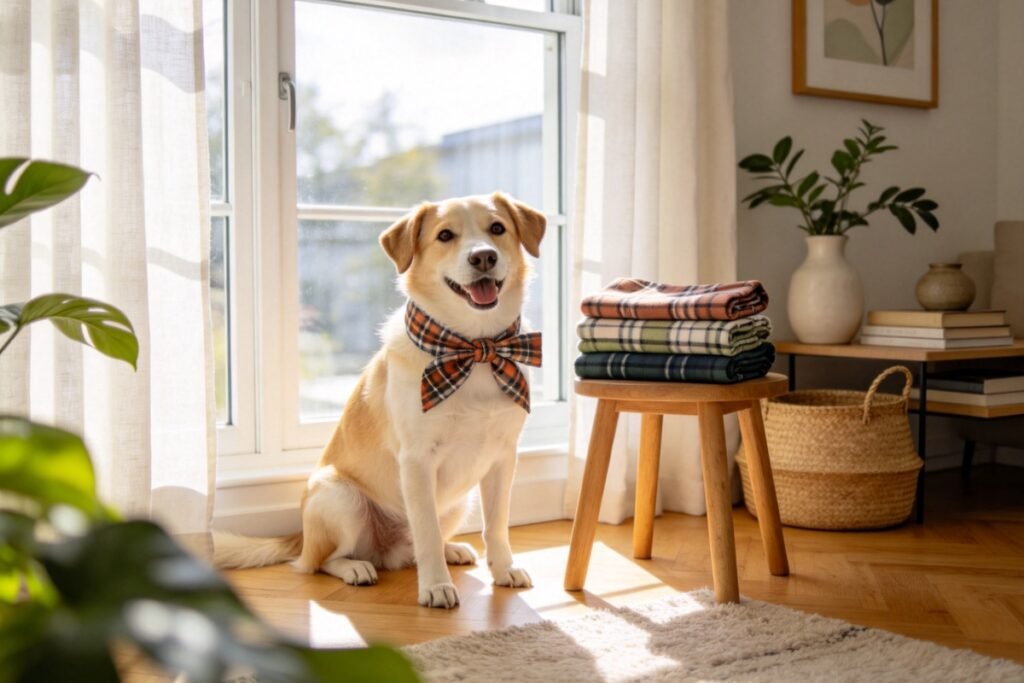
Red-and-black or black-and-white plaid is the workhorse. It reads as “cozy” from October through February, suits every coat color, and hides dirt better than any pastel. Tie it with the overhand knot in flannel for autumn weight. Plaid also layers beautifully under a knit — pair it with one of the cute dog sweaters for small dogs and let just the point of the triangle show below the collar.
2. Seasonal Florals for Spring
Small-scale ditsy florals on white or sage cotton photograph far better than large tropical prints, which visually swallow small dogs. Use the necktie fold so the print stays flat and readable rather than bunched.
3. Personalized Name or Phone-Number Embroidery
An embroidered name bandana is part style, part backup ID. Keep the text to a first name plus one phone number, and choose a contrasting thread — navy on cream, white on black. This is the single most-gifted bandana style and the one most likely to survive years of washing, since embroidery doesn’t fade the way screen printing does.
4. Halloween and Christmas Holiday Looks
Pumpkins in October, tartan and snowflakes in December. Holiday bandanas are the low-stress alternative for dogs who won’t tolerate a full costume — a huge deal for anxious dogs. If you are going full costume, our guide to the best dog Halloween costumes 2026 ranks the comfort-first designs.
5. Tonal Monochrome with a Matching Collar
Pick a bandana within one shade of the collar — charcoal bandana on a black collar, oatmeal on tan. Tonal styling looks deliberate and expensive, and it’s the easiest way to make a mixed-brand setup look like a coordinated set.
6. Bandana Layered Over a Sweater
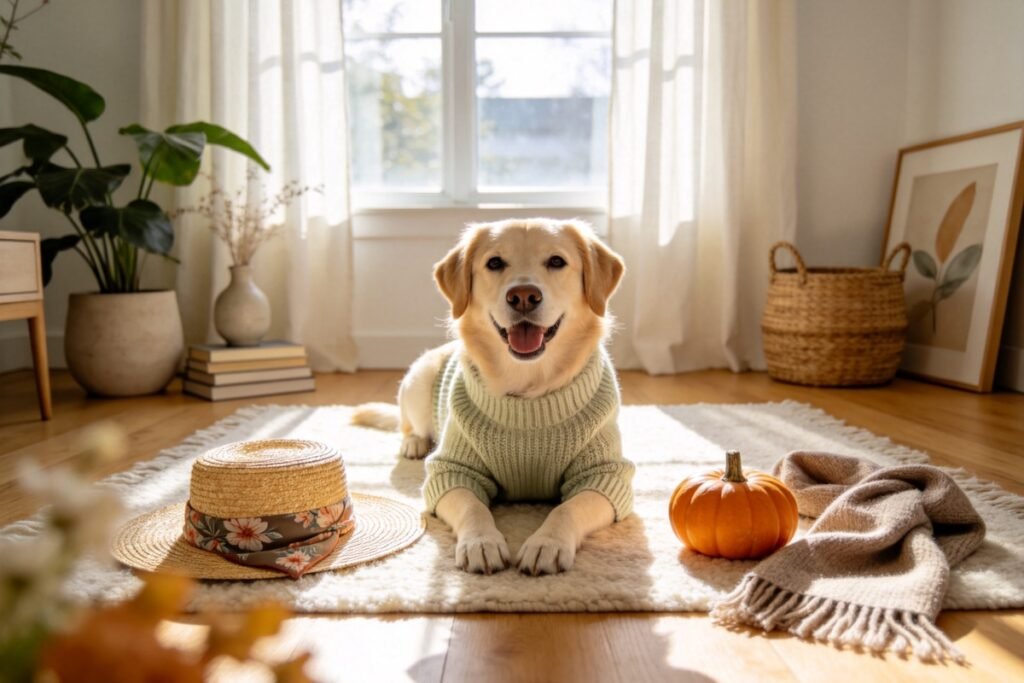
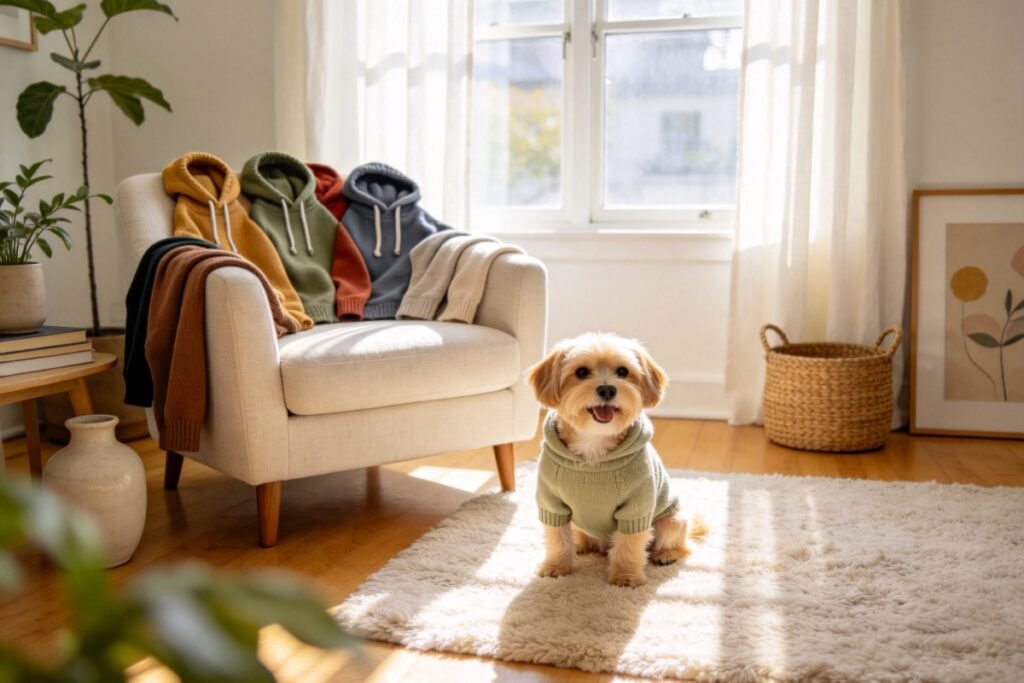
Sweater first, bandana over the top, tied with the necktie fold so it sits on the knit rather than under it. This adds a second color and breaks up a large single-color garment. Works especially well on fluffy breeds where the sweater tends to visually merge with the coat.
7. Owner-Matching Bandana and Scarf
Buy a human scarf or shirt in the same print family — not identical, just the same palette. Matching sets are the highest-engagement content in pet fashion, and we break down the full approach in matching owner and dog outfit ideas.
8. Reversible Two-Print Bandana
Reversible squares give you two looks per purchase — typically a bold print on one side and a plain complementary color on the other. Flip to the solid side for cleaner photos, flip to the print for personality. Best value per dollar in the category.
9. Cooling Bandana for Summer Walks
A soak-and-wear cooling bandana uses evaporation to drop neck-surface temperature during hot weather. Tie it with the overhand knot so it stays put once wet and heavier. It’s the one bandana with genuine safety value — see summer dog bandanas and cooling vests for how it fits into a full heat-management plan.
(Prices and stock can change; always verify on Amazon.)
Sizing: Matching Bandana Size to Neck Girth
Bandanas are forgiving, but a too-small square can’t be tied safely and a too-large one drags in water bowls.
| Bandana size | Square edge (approx.) | Neck girth | Typical dogs |
|---|---|---|---|
| XS/S | 12–16 in | 8–14 in | Chihuahua, Yorkie, Pom, kittens |
| M | 18–22 in | 14–18 in | Beagle, Frenchie, Corgi, Cocker |
| L | 24–26 in | 18–24 in | Lab, Golden, Boxer, Aussie |
| XL | 28+ in | 24–30 in | Great Dane, Mastiff, Newfoundland |
Rules of thumb:
- For a tied square, you want at least 6 inches of fabric left over after wrapping the neck so the knot has something to work with.
- For over-the-collar styles, size by the collar width the hem channel can accept, not by neck girth.
- If you’re between sizes, go larger — you can fold a big bandana down, but you can’t stretch a small one.
Fabric Guide: Cotton, Flannel, Mesh, and Cooling Weaves
- Quilting-weight cotton — the default. Prints stay crisp, it washes hot, it dries fast, and it folds to a clean point. Best all-round choice.
- Flannel — soft, thicker, autumn-appropriate. Holds a knot better than thin cotton but takes longer to dry and pills over time.
- Linen blends — beautiful drape and a premium look for photos, but wrinkles instantly and frays if the edges aren’t finished properly.
- Mesh / performance knit — breathable and light, best for hot climates and active dogs. Prints are usually simpler.
- PVA or hydro-cooling fabric — engineered to hold water and cool through evaporation. Feels slightly stiff dry, soft when wet. Seasonal, not everyday.
Check the edge finish before anything else. A double-turned hem or serged edge outlasts a raw or single-stitched edge by a wide margin, and a fraying bandana looks scruffy after three washes regardless of print quality.
Blueberry Pet vs Rogz: Brand Comparison
| Feature | Blueberry Pet | Rogz |
|---|---|---|
| Design focus | Seasonal prints, coordinated sets | Bold solids, durable webbing accessories |
| Matching gear | Extensive (collar, leash, harness, sweater) | Collars and leashes |
| Typical fabric | Cotton and cotton blends | Performance-leaning fabrics |
| Best tie method | Necktie fold, overhand | Over-the-collar drape |
| Size range | XS–L | S–XL |
| Standout strength | Wardrobe coordination | Everyday toughness |
| Buy |
Both brands appear repeatedly in 4★+ listings. Blueberry Pet is the pick when you’re building a coordinated look across several pieces; Rogz is the pick when the bandana needs to survive a dog who swims, digs, and wrestles. Specs and print availability rotate seasonally — check current details on Amazon.
Safety Rules and Who Should Skip Bandanas
Bandanas are low-risk, not zero-risk. Follow these:
- Two-finger rule. If you can’t slide two flat fingers under the tied fabric, it’s too tight.
- Never leave a tied bandana on an unsupervised dog. Knots tighten during play, and loose ends catch on crate wire, fences, and other dogs’ teeth. Over-the-collar styles with breakaway hardware are the safer overnight option — better still, take it off.
- Watch multi-dog play. A bandana is a grab handle. Remove them at daycare and dog parks.
- Check for chafing at the underside of the neck after the first few wears, especially on short-coated dogs.
- Don’t cover the collar ID tag with the bandana point.
Who should skip them: Brachycephalic dogs with tracheal sensitivity when the fabric is thick and tied at the throat (use over-the-collar instead), dogs who chew fabric compulsively, and dogs recovering from neck or throat surgery.
What to look for: Far too many bandana listings sell a plain square with no neck-girth guidance at all, leaving buyers to guess. It would help if more brands to offer breakaway snap closures as standard rather than as a premium upgrade — it’s a cheap feature that meaningfully reduces snag risk.
Washing and Keeping Prints Sharp
- Wash cold, inside out, with like colors. Hot water is what fades screen-printed designs.
- Skip bleach entirely, including “color-safe” versions on printed cotton.
- Air dry or tumble low. High heat shrinks cotton squares by up to an inch, which changes how they tie.
- Iron on the reverse side for crisp photo-ready folds — never directly on a printed face.
- Rotate three bandanas rather than washing one repeatedly; you’ll triple the effective lifespan.
Keep a spare in the car and one by the door — it’s the accessory most likely to end up muddy right before you want a photo. And when the bandana comes off, the reward is usually a nap: our guides to the best orthopedic dog beds and stylish cat beds for the living room cover the resting half of pet life.
FAQ
How tight should a dog bandana be tied?
Loose enough to slide two flat fingers between the fabric and your dog’s neck. Knots tighten during play, so re-check after ten minutes of activity. If you want zero tightening risk, use an over-the-collar bandana that threads onto the collar instead of being tied.
What size bandana does my dog need?
Match the square’s edge length to neck girth plus at least six inches of spare fabric for the knot. Small breeds like Chihuahuas and Yorkies take a 12–16 inch square; Labs and Goldens take 24–26 inches; giant breeds need 28 inches or more. When between sizes, buy larger and fold down.
Can dogs wear bandanas all day?
Supervised, yes — a properly tied bandana is comfortable for hours. Don’t leave one on overnight, in a crate, or during unsupervised play, because loose ends and knots create a snag hazard. Remove it at dog parks and daycare where other dogs can grab it.
What are the easiest dog bandana styling ideas for beginners?
Start with buffalo plaid tied in an overhand knot — forgiving fabric, forgiving knot, works with every coat color. Then try a tonal bandana matched to your dog’s collar, and a personalized embroidered name square. Those three cover casual, polished, and gift-worthy without any technique to learn.
Do cooling bandanas actually work?
Yes, modestly. Evaporative cooling bandanas lower the temperature at the neck surface where blood vessels run close to the skin, which helps a dog feel more comfortable. They are a supplement to shade, water, and shorter midday walks — not a substitute, and not sufficient protection in high humidity where evaporation slows.
Our Pick
Blueberry Pet is our overall winner for dog bandana styling ideas. The reason is range: their seasonal print rotation plus matching collars, leashes, and sweaters means one bandana purchase can anchor an entire coordinated wardrobe rather than sitting as a one-off. Print quality holds up through repeated cold washes, and the sizing spans small breeds properly.
Choose Rogz instead if your dog swims, digs, and roughhouses — durability beats print variety when the accessory takes daily abuse.
Best single technique to learn first: the over-the-collar triangle drape. It removes knot-tightening risk entirely and takes five seconds.
(Prices and stock can change; always verify on Amazon.)
Want more seasonal pet-style ideas? Subscribe via HiPetTech’s about page for new looks, sizing charts, and straight verdicts.
Disclosure \& Transparency
This post contains affiliate links to Amazon and other retailers. As an Amazon Associate, we earn from qualifying purchases at no extra cost to you. This site is research-based: recommendations are built from brand specifications, large-scale user reviews, long-term feedback in pet communities, and reliability signals such as firmware updates and parts availability. We do not claim personal in-house testing of every unit. Prices and stock levels can change at any time; always verify on the retailer’s page before purchasing. Read our full editorial and affiliate policy →