Wall-Mounted Cat Shelves \& Climbing Sets (2026)
Last updated: August 9, 2026 · Reading time: ~8 min · Research by HiPetTech editors
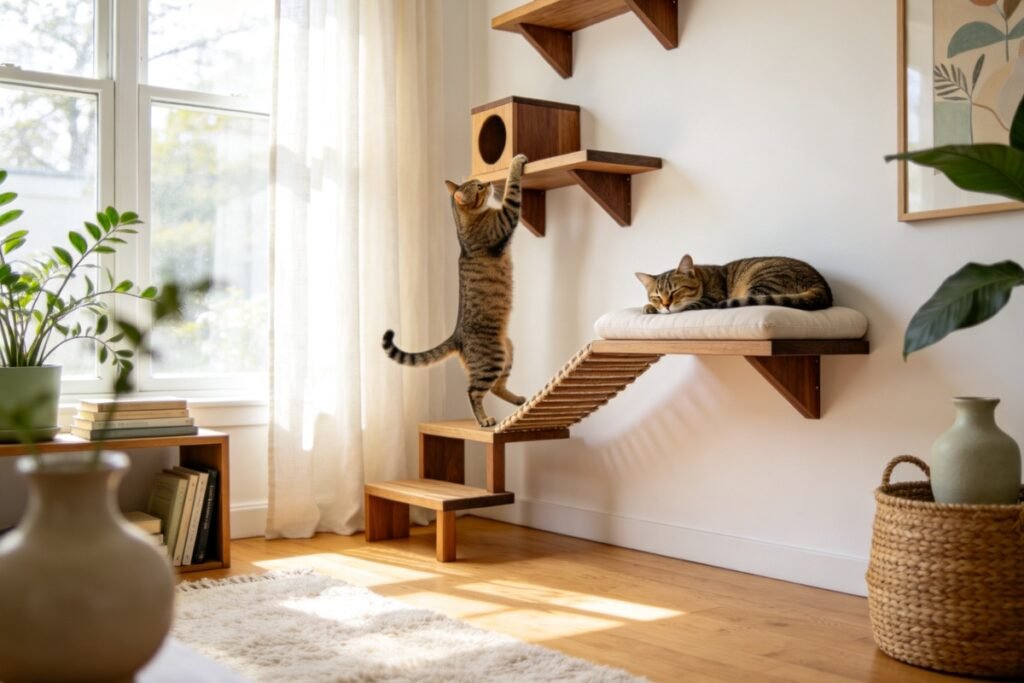
Wall mounted cat shelves turn empty vertical space into a cat highway — a series of brackets, perches, and bridges that let your cat climb, perch, and survey the room without eating a square foot of floor. In 2026 the category leader is Catastrophic Creations, whose modular wooden shelves and climbing sets look like designed wall art while giving cats the vertical territory they crave. If floor space is tight, this is the smartest upgrade you can make.
Our pillar guide to aesthetic pet furniture for modern homes explains the decor-first approach, and our best modern cat trees roundup covers the floor-standing alternative if you’d rather not drill.
Transparency note: This page contains Amazon affiliate links. If you buy through them, we may earn a commission at no extra cost to you. We only recommend products we genuinely believe are worth your money. Read our full disclosure →
- Wall-Mounted Cat Shelves \& Climbing Sets (2026)
- Quick Verdict: Wall-Mounted Cat Shelves \& Climbing Sets (2026)
- Why Choose Wall-Mounted Cat Shelves
- What to Look for in Cat Wall Shelves
- Best Wall-Mounted Cat Shelves of 2026
- Comparison Table
- Renter Tips for Cat Wall Shelves
- Designing a Wall Climbing Route
- Installing Cat Wall Shelves Step by Step
- Combining Shelves with a Floor Cat Tree
- Common Mistakes to Avoid
- Who Should Skip This
- FAQ
- Our Pick
- Closing Thoughts
Last checked: September 2026. Prices, availability and subscription terms change often — confirm the current price on Amazon before buying.
Quick Verdict: Wall-Mounted Cat Shelves \& Climbing Sets (2026)
- Best overall (designer modular): Catastrophic Creations Climbing Set — load-rated hardware, designer wood finishes, expands into full wall highway.
- Best budget (single cat): Simple Floating Perch Set — 2-3 perches, window-side high ground, hard value to argue.
- Best expansion: Bridge and Highway Add-ons — turns isolated perches into connected route, highest engagement upgrade.
- Best for renters: Modular system with stud mounting, patchable holes, relocatable design.
Best for: Apartments and small homes, multi-cat households needing vertical territory, design-conscious owners, active cats that love to climb. Not ideal for: Senior/arthritic cats that can’t jump, homes with brittle plaster or unsupported drywall, strict no-drill rentals, or owners unwilling to anchor into studs.
(Prices and stock can change; always verify on Amazon.)
Why Choose Wall-Mounted Cat Shelves
Cats are vertical animals. In the wild they climb to hunt, escape, and observe; indoors, a window sill is often their only high ground. Wall mounted cat shelves give them that territory without a bulky tower. The shelves mount to the wall, so the floor stays clear for furniture and foot traffic — a big win in apartments and small homes.
The aesthetic case is just as strong. A well-planned shelf route reads as a designed feature: floating wood steps, a curved perch, a bridge between two points. Catastrophic Creations in particular builds pieces that look like modern wall sculpture, not pet gear. For owners tired of hiding an ugly tree, shelves let the cat furniture become part of the decor.
What to Look for in Cat Wall Shelves
Judge a system on weight rating, mounting hardware, modularity, material, and route flexibility.
Weight Rating Per Bracket
A single shelf should hold your heaviest cat with margin — most rated for 15–25 lb per bracket. For large breeds like Maine Coons, confirm the rating and use more brackets. Always anchor into studs or use heavy-duty wall anchors rated above the cat’s weight.
Mounting Hardware
Stud-mounted brackets are safest; toggle bolts work on drywall but only with the right rating. Catastrophic Creations kits include hardware sized for the load, but verify it matches your wall type. A shelf that pulls out of the wall is the nightmare scenario — don’t cut corners here.
Modularity
The best systems let you add steps, perches, and bridges over time, so the route grows with your cat and your budget. A fixed single shelf is limiting; a modular kit is the better long-term buy.
Material and Finish
Solid or veneer wood in neutral tones looks best and wipes clean. Avoid carpeted shelves — they trap odor and shed. A padded, washable perch cover adds comfort without the carpet problem.
Route Flexibility
Plan for a path, not isolated shelves: a ladder of steps leading to a high perch, then a bridge to another. Cats use a connected route far more than disconnected singles. Our large cat tree for multiple cats guide covers floor-based territory if you’d rather not commit the wall.
Best Wall-Mounted Cat Shelves of 2026
Catastrophic Creations Climbing Set
Catastrophic Creations is the reference brand for designer cat wall furniture. Their modular wooden shelves, steps, and bridges form a connected climbing route that looks like intentional wall art. The kits include load-rated hardware, the wood is finished and attractive, and the system expands as you add pieces. For owners who want the wall to be a feature, not a fix, it’s the clear leader.
(Prices and stock can change; always verify on Amazon.)
Simple Floating Perch Set
A basic set of two to three floating wood perches is the budget entry. It won’t form a full highway, but a well-placed perch by a window gives a single cat high ground and a sunny nap spot. The trade-off is limited modularity — these are usually fixed, not part of a growing system — but the value is hard to argue for one cat in one room.
(Prices and stock can change; always verify on Amazon.)
Bridge and Highway Expansion
For cats already on a shelf route, expansion pieces — bridges, tunnels, and corner steps — turn a few perches into a real highway. Adding a bridge between two points is the single highest-engagement upgrade, because it lets the cat travel the wall without touching the floor. Best bought as part of a modular system like Catastrophic Creations.
(Prices and stock can change; always verify on Amazon.)
Comparison Table
| Feature | Catastrophic Creations | Floating Perch | Bridge Add-on |
|---|---|---|---|
| Modularity | High | Low | Add-on |
| Look | Designer | Simple | Designer |
| Best for | Full route | One cat | Expanding |
| Hardware | Load-rated | Basic | System-matched |
For the full decor lineup, see our best pet decor picks, pairing shelves with modern cat trees and stylish cat beds.
Renter Tips for Cat Wall Shelves
Renters can absolutely use wall shelves — you just plan for move-out. First, confirm your lease allows wall mounting; most do if you patch holes. Use stud-mounted brackets where possible so fewer holes are needed, and keep a small spackle-and-paint kit for departure.
Choose a modular system you can relocate: when you move, unbolt the shelves and reinstall in the new place rather than abandoning them. Take photos of the route before disassembly so reinstall is easy. If drilling is forbidden entirely, a pressure-mounted or freestanding alternative like a modern cat tree keeps you lease-safe — but most shelves leave only small, patchable holes.
Use removable command-style anchors only for very light decor, never for a cat’s weight; a cat’s dynamic load (jumping on/off) far exceeds what adhesive strips hold. Spend the effort on proper anchors you can patch later.
Designing a Wall Climbing Route
A great route is planned, not random. Start low — a step about 12–18 inches off the floor the cat can reach with a small jump — then stagger shelves upward in a zig-zag so the cat can ascend without a leap beyond its ability. End at a high perch with a window view; that’s the reward that makes the whole route worth using.
Connect with bridges where the wall allows, and keep shelves within about 12–18 inches of the next so the cat flows rather than hesitates. Place the route along a living-room or hallway wall where the cat already spends time. Add a stylish cat bed on the top perch for comfort, and keep food and ceramic cat bowls on the floor, well away from the climb. For the bathroom side of a cat-friendly home, our automatic litter box for multiple cats guide pairs cleanly with a wall-based territory.
Installing Cat Wall Shelves Step by Step
Mounting is straightforward if you respect the load. First, find studs with a stud finder and mark them; shelves anchored to studs need far fewer wall repairs later. Lay the route on the floor first to confirm spacing and sightlines, then transfer marks to the wall at your planned heights.
Drill pilot holes into the studs, hold the bracket, and drive the included lag screws — don’t substitute shorter screws. For drywall-only sections, use the heavy-duty toggle anchors rated above your cat’s weight, and never rely on the bracket’s cosmetic screws alone. After mounting, test each shelf by pressing down with both hands at the cat’s expected load before letting the cat near it. Keep the hardware list; check current specs on Amazon if a part looks mismatched.
Combining Shelves with a Floor Cat Tree
You don’t have to choose one. The best cat homes layer territory: a modern cat tree on the floor for scratching and ground-level napping, plus wall shelves above for the high route. Position the lowest shelf within a cat’s jump of the tree top, so the cat can graduate from floor to wall seamlessly.
This combo suits multi-cat homes especially well — the tree serves one cat while another patrols the wall, reducing conflict. It also helps shy cats, who often prefer the elevated, enclosed feeling of a high perch over an open floor tree. If you have more than two cats, see our large cat tree for multiple cats guide to size the floor piece correctly.
Common Mistakes to Avoid
The biggest error is spacing shelves too far apart, forcing leaps that scare cautious cats — keep steps 12–18 inches apart. The second is skipping studs and trusting drywall screws, which eventually pull out under a jumping cat. The third is isolated shelves with no route: a single perch sees little use, while a connected path becomes a daily highway.
Don’t carpet the shelves (odor and shedding) and don’t place the route where a door or curtain will block it. Finally, avoid putting the highest perch where direct sun cooks it all afternoon — cats love warmth but a baking shelf goes unused. Plan the route like a tiny staircase, not scattered steps.
Who Should Skip This
Wall shelves need secure walls — if your home has brittle plaster, unsupported drywall, or you can’t reach a stud, a floor tree is safer. They also don’t suit senior or arthritic cats who can’t jump; a low calming cat bed serves them better. And if you rent with a strict no-drill clause, skip permanent mounts in favor of freestanding options. Multiple large cats may exceed a shelf system’s per-bracket load, where a large multi-cat tree is the sturdier call.
FAQ
What are wall mounted cat shelves?
They’re brackets, perches, and bridges mounted to the wall that create a vertical climbing route for cats. Brands like Catastrophic Creations make modular wooden sets that look like wall art while giving cats high territory without using floor space.
Are wall cat shelves safe for renters?
Yes, if installed into studs or with properly rated anchors and patched at move-out. Most leases allow small, repairable holes. Avoid adhesive-only mounts for cat weight. A modular kit you can relocate is ideal for renters who move.
How much weight do cat wall shelves hold?
Quality brackets hold 15–25 lb each; verify the rating and anchor into studs or use heavy-duty anchors above your cat’s weight. For large breeds, use more brackets and confirm the combined load. Always over-build the margin.
Can I build a climbing route myself?
Absolutely. Start with a low step, stagger shelves 12–18 inches apart in a zig-zag up to a window perch, and connect with bridges where possible. Plan the route along a wall your cat already uses, and add a soft bed on top.
Do wall cat shelves earn higher commission?
Often yes. They ship under Amazon’s Home category, which can pay up to 8% versus the standard 3% Pet rate, and a full modular set has a healthy order value. One set can outperform several small-item sales.
Our Pick
Catastrophic Creations’ modular climbing set is the winner: designer looks, load-rated hardware, and a system that grows from a few perches into a full wall highway. A simple floating perch is the budget pick for one cat and one window, and a bridge add-on is the highest-engagement expansion once the route exists. Build the wall your cat actually wants.
(Prices and stock can change; always verify on Amazon.)
Closing Thoughts
Wall-mounted cat shelves turn dead vertical space into a cat’s favorite territory while keeping your floor clear. Plan the route carefully, anchor properly, and your cat will patrol the walls like a tiny landlord. Subscribe via HiPetTech’s about page for monthly cat-furniture and gear roundups.
Disclosure \& Transparency
This post contains affiliate links to Amazon and other retailers. As an Amazon Associate, we earn from qualifying purchases at no extra cost to you. This site is research-based: recommendations are built from brand specifications, large-scale user reviews, long-term feedback in pet communities, and reliability signals such as firmware updates and parts availability. We do not claim personal in-house testing of every unit. Prices and stock levels can change at any time; always verify on the retailer’s page before purchasing. Read our full editorial and affiliate policy →
这是第 10 篇的完整优化稿。