Best Automatic Wet Food Feeders for Cats (2026): Keeping Meals Fresh
Last updated: August 2, 2026 · Reading time: ~7 min · Research by HiPetTech editors
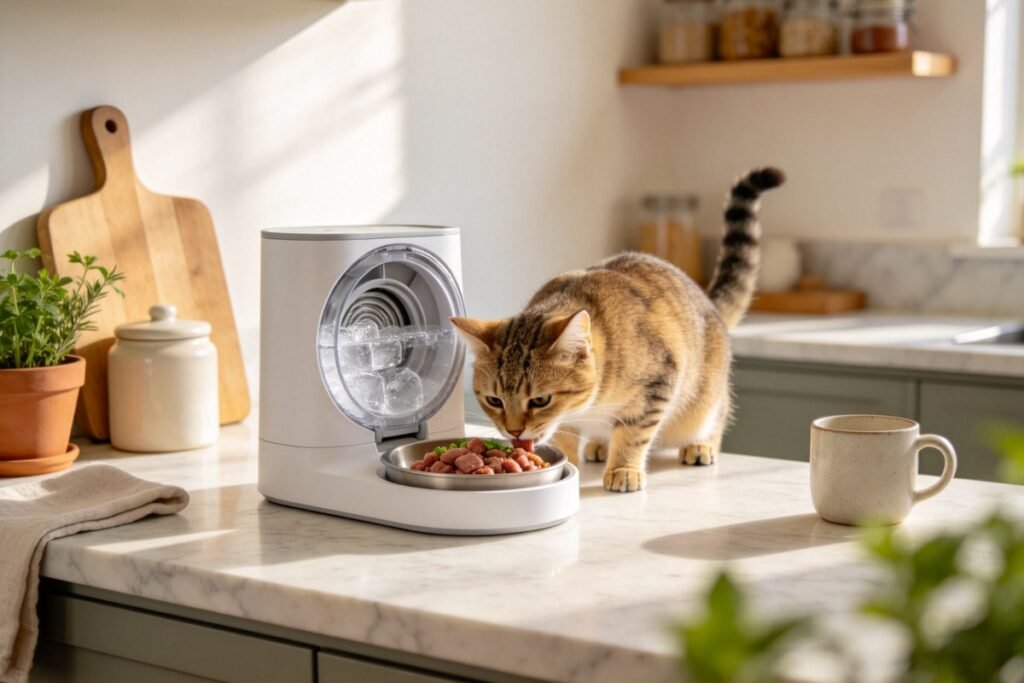
An automatic wet food feeder for cats keeps pouch and can meals safe between servings by cooling the bowl instead of leaving food at room temperature. Our top pick is the PETLIBRO Polar, which uses semiconductor cooling to hold a meal fresh for up to about 72 hours. If your cat refuses kibble, this guide pairs well with our best smart pet feeders for cats list and the deeper PETLIBRO Granary smart feeder review. Start with our best smart pet gear of 2026 hub for the full landscape.
Transparency note: This page contains Amazon affiliate links. If you buy through them, we may earn a commission at no extra cost to you. We only recommend products we genuinely believe are worth your money. Read our full disclosure →
- Best Automatic Wet Food Feeders for Cats (2026): Keeping Meals Fresh
- Quick Verdict: Best Automatic Wet Food Feeders (2026)
- Why an Automatic Wet Food Feeder for Cats Beats a Hopper
- How Cooling Wet Food Feeders Work
- #1 PETLIBRO Polar (Semiconductor Cooling)
- #2 Ice-Pack Feeders (Cat Mate C500)
- Comparison: PETLIBRO Polar vs Cat Mate C500
- Food Safety: What the FDA Says
- When Cooling Beats a Standard Hopper
- real limits of Wet Food Feeders
- How to Choose the Right Model
- FAQ
- Our Pick
Last checked: September 2026. Prices, availability and subscription terms change often — confirm the current price on Amazon before buying.
Quick Verdict: Best Automatic Wet Food Feeders (2026)
- Best overall (active cooling): PETLIBRO Polar — semiconductor cooling, ~72-hour freshness window, purpose-built for packaged wet food.
- Best budget (passive cooling): Ice-pack feeders like Cat Mate C500 — frozen pack beneath the bowl keeps food colder than room temperature for several hours; ideal for a single workday portion.
Best for: Cats on veterinary wet-food diets, grazers who prefer several small meals, or owners who work long shifts and need safe, pre-loaded meals. Not ideal for: Raw diets (these feeders are not designed for raw feeding), very hot rooms without AC, or owners who want large-capacity, multi-day dry kibble feeding.
(Prices and stock can change; always verify on Amazon.)
Why an Automatic Wet Food Feeder for Cats Beats a Hopper
A dry-kibble hopper simply cannot serve wet food safely. Once a pouch is opened, the contents spoil quickly at room temperature, and a standard feeder has no way to keep them cold. An automatic wet food feeder for cats solves this with active or passive cooling, so you can pre-load a breakfast and trust it stays edible until the scheduled open time.
For cats on veterinary wet-food diets, grazers who prefer several small meals, or owners who work long shifts, this is the difference between safe feeding and risky leftovers. Cooling extends the safe window dramatically compared with leaving a bowl out, which is why we recommend a cooled feeder over any dry-only device for wet-food cats.
The trade you accept is smaller capacity and a higher price than a basic kibble hopper, plus a little more daily upkeep. For many cat owners, that trade is worth it the first time a cooled feeder saves a hot-day portion that would otherwise have been tossed.
How Cooling Wet Food Feeders Work
There are two main cooling approaches.
1. Semiconductor (Thermoelectric) Cooling
Used by the PETLIBRO Polar. A small solid-state cooler draws heat from the bowl chamber, holding a low temperature without compressors or gases. It is quiet and compact, and it keeps a sealed portion fresh for a long stretch.
2. Ice-Pack Cooling
Used by units like the Cat Mate C500. A reusable frozen pack sits beneath the bowl and slows warming for several hours. It is lower-tech and cheaper, but its cooling duration depends on the pack and room temperature, and you must refreeze and reload packs regularly.
Both methods beat no cooling at all; the choice is about convenience versus runtime. If you want “set it and forget it” for days, semiconductor is the clear winner. If you are happy to babysit a pack for a single day, ice is enough. Understanding that split is the fastest way to pick the right tier and avoid overspending on features you will not use.
#1 PETLIBRO Polar (Semiconductor Cooling)
The PETLIBRO Polar is our top pick because it actively cools rather than relying on a melting ice pack. Its semiconductor system can hold a wet-food portion fresh for roughly 72 hours, which is enough to pre-load a full day or more of meals with confidence. That runtime is the headline advantage over passive competitors.
It fits the Granary family’s reputation for solid app control and dependable build, and it is purpose-built for packaged wet food rather than improvised hacks. Because the cooling is active, you are not racing a melting ice pack — the chamber stays cold on its own schedule, which is what makes the multi-day window realistic rather than optimistic.
In daily use, that means you can load dinner before bed and trust lunch the next day is still safe, or pre-stage a weekend of meals for a sitter-proof routine. The plain caveat: it is designed for commercial wet food, not raw diets, so do not use it for raw feeding. For most wet-food cats, it is the safest, most hands-off option we recommend.
(Prices and stock can change; always verify on Amazon.)
Best for: Multi-day feeding, warm rooms, owners who want active cooling without refreezing packs.
#2 Ice-Pack Feeders (Cat Mate C500)
Ice-pack feeders like the Cat Mate C500 are the budget-friendly entry to cooled feeding. A frozen pack beneath the bowl keeps food colder than room temperature for several hours, making them ideal for a single workday portion or a cooler home. Setup is simple and there is no compressor noise.
The limitation is runtime: as the pack warms, protection fades, so these suit shorter windows better than multi-day absences. You also commit to a refreeze-and-reload routine, which is easy at home but annoying if you forget. In a cooler climate or air-conditioned apartment, however, an ice pack can comfortably cover a standard workday.
For cat owners who want cooled feeding without the cost of semiconductor tech, an ice-pack model is a pragmatic starting point. It teaches you whether a cooled routine even fits your cat before you invest in active cooling.
(Prices and stock can change; always verify on Amazon.)
Best for: Single cool-day portions, budget-conscious owners, cooler homes or AC environments.
Comparison: PETLIBRO Polar vs Cat Mate C500
| Feature | PETLIBRO Polar | Cat Mate C500 |
|---|---|---|
| Cooling type | Semiconductor (active) | Ice pack (passive) |
| Freshness window | ~72 hours | Several hours |
| Best for | Multi-day / warm rooms | Single cool day |
| Refreeze needed | No | Yes |
| Price |
(Prices and stock can change; always verify on Amazon.)
Food Safety: What the FDA Says
Food safety is the entire reason to buy a cooled feeder. General FDA guidance on perishable pet food advises refrigeration of wet and raw-style foods and cautions against leaving them at room temperature for extended periods, since bacteria multiply quickly once a pouch is opened. A cooled feeder directly addresses that risk by holding the meal in a low-temperature chamber until serving.
Practical rules we follow:
- Pre-chill the feeder
- Load cold food straight from the fridge
- Never assume cooling extends safety indefinitely in a hot room
Treat the manufacturer’s freshness window as a ceiling, not a target, and discard anything that looks or smells off. When in doubt, shorter holds are always safer than pushing the limit.
It also helps to keep the feeder out of direct sun and away from ovens or radiators, since ambient heat quietly erodes any cooler’s performance. A clean bowl between loads matters too — residue from a previous meal can spoil faster than the fresh portion you just added. Good hygiene, not just good cooling, is what keeps wet feeding safe day after day.
When Cooling Beats a Standard Hopper
Cooling wins whenever the food itself is perishable. If your cat eats only wet food, a dry hopper is simply the wrong tool — it cannot serve or preserve pouches at all. Cooling also beats a hopper for grazers who return to a meal across the day, because each revisit happens against a chilled portion rather than a warming one.
The reverse is also true: if your cat is happy on kibble, a cooled feeder adds cost and complexity you do not need. In that case our best smart pet feeders for cats ranking points you to dry models. Match the mechanism to the meal, and the rest of the decision gets easy.
A useful middle path exists too: some homes run a cooled wet feeder for daytime pouches and a dry hopper for overnight kibble, giving the cat variety without sacrificing safety. That combo works especially well for grazers who like options but have owners with unpredictable schedules.
real limits of Wet Food Feeders
We will not oversell these. Key limits:
- Not for raw diets. The Polar and similar cooled units are built for packaged commercial wet food, not raw feeding, which needs stricter temperature control.
- Warm rooms shorten safety. In a hot, non-air-conditioned space, any cooler’s effective freshness window drops.
- Smaller capacity. Cooled bowls hold less than big dry hoppers, so very frequent feeders need more reloads.
- Power dependence. Semiconductor models need electricity; confirm backup behavior on the listing before relying on them unsupervised.
None of these are dealbreakers for typical homes, but they are the straight boundaries you should plan around. A cooled feeder is a tool with a defined envelope, not a magic box that defeats biology. Respect the window and it will serve you well; ignore it and you are back to risky leftovers. For dry-kibble reliability instead, see our PETLIBRO Granary smart feeder review.
How to Choose the Right Model
Start with your cat’s routine:
- One wet meal while you work? An ice-pack feeder may suffice.
- Multiple meals across a day or longer absences? Step up to semiconductor cooling like the Polar.
Then check bowl count — single versus dual bowls matters for multi-cat homes or medication separation.
Next, confirm the freshness window against your longest real gap between refills, and verify the unit fits your cat’s favorite can or pouch size. Some bowls are shallow and wide, others deep, and an awkward fit means wasted food or a lid that will not seal. Read the dimensions against your usual packaging before buying.
Finally, think about watching your pet: pairing any feeder with a best pet camera for cats lets you confirm the meal was actually eaten and the bowl stayed closed. For wet food especially, a camera catches a cat who nudges the lid open or a portion ignored long enough to spoil — visibility that turns a smart feeder into a complete care system.
Still deciding whether a smart feeder is the right first purchase at all? Our Smart Pet Gear Buying Guide walks through the seven questions worth asking before any smart device enters your home.
FAQ
How long can a cooled wet food feeder keep food fresh?
Semiconductor models like the PETLIBRO Polar can hold a portion fresh for roughly 72 hours, while ice-pack units last several hours depending on the pack and room temperature. Always treat the maker’s window as a maximum and use shorter holds in hot rooms.
Can I use an automatic wet food feeder for raw cat food?
No. These feeders are designed for packaged commercial wet food, not raw diets, which require stricter temperature control. For raw feeding, consult your veterinarian and use purpose-built refrigeration rather than a pet feeder.
Is an ice-pack feeder safe for a full workday?
Usually yes in a cool home, since the frozen pack keeps the bowl below room temperature for several hours. In a warm room or for longer gaps, a semiconductor-cooled model is the safer choice because its cooling does not depend on a melting pack.
Do wet food feeders work for multiple cats?
Some offer dual bowls or separate compartments, which help with multiple cats or medication. For food-stealing, pair a cooled feeder with an RFID dry feeder like the Granary One, since most wet feeders do not lock access by pet.
Do I still need to refrigerate the food first?
Yes. Load food straight from the fridge and pre-chill the feeder when possible. Cooling slows bacterial growth but does not reset the clock on food that was already left out, so start cold for the safest result.
Our Pick
The PETLIBRO Polar is our clear winner for most wet-food cats: active semiconductor cooling, a roughly 72-hour freshness window, and Granary-grade build quality in one purpose-built device. It is the feeder we would buy for our own wet-food cats.
(Prices and stock can change; always verify on Amazon.)
If your needs are lighter and your budget tighter, an ice-pack feeder like the Cat Mate C500 covers a single cool-day portion at a lower cost. Either way, the goal is the same: serve wet food that is still safe to eat, not a bowl you have to throw away. Browse all current best picks to compare across our 2026 pet-tech rankings.
Want more cat-care tech reviews and deals? Join our newsletter at HiPetTech’s About page.
Disclosure \& Transparency
This post contains affiliate links to Amazon and other retailers. As an Amazon Associate, we earn from qualifying purchases at no extra cost to you. This site is research-based: recommendations are built from brand specifications, large-scale user reviews, long-term feedback in pet communities, and reliability signals such as firmware updates and parts availability. We do not claim personal in-house testing of every unit. Prices and stock levels can change at any time; always verify on the retailer’s page before purchasing. Read our full editorial and affiliate policy →